You’ve been told a hundred times: meditate for twenty minutes, do yoga at sunrise, journal three pages every morning. And if you’re anything like most adults in India juggling work, family, and the mental load of daily life, you’ve probably tried once or twice—then quietly given up because it felt like adding another chore to an already impossible list.
Here’s the truth: stress relief doesn’t have to be a second job. What works for you depends on how much energy you actually have in the moment. Some days you can handle a brisk walk; other days, even that feels like climbing a mountain. The secret isn’t finding the “perfect” technique—it’s building a menu of options that match your energy level, so you always have something that feels doable.
Let’s break it down by what you can realistically manage right now.
Low-energy resets (when you’re running on fumes)
You’re exhausted. Your brain is foggy. The idea of “self-care” makes you want to laugh—or cry. These are for those moments.
Cold water on your hands and wrists. Run cold tap water over your hands and the inside of your wrists for 30 seconds. The shock to your nervous system interrupts the stress loop and brings you back to your body. It’s physical, immediate, and requires zero mental effort.
A music walk (even just around the house). Put on one song you love—something with a beat or a melody that shifts your mood—and walk. Around your flat, down the corridor, or just back and forth in your room. Movement + sound = a quick reset without having to “exercise.”
The 60-second stretch. Stand up. Roll your shoulders back five times. Tilt your head gently to each side. Reach your arms overhead and take three deep breaths. You’re not trying to become flexible; you’re just reminding your body it’s allowed to relax.
These aren’t solutions to big problems, but they’re circuit breakers—and sometimes that’s all you need to get through the next hour.

Medium-energy activities (when you have a bit more in the tank)
You’re not at 100%, but you’re not completely drained either. You can handle something that takes a little focus or movement.
The 10-minute declutter sprint. Set a timer for ten minutes. Pick one small area—your desk, a kitchen counter, the top of your dresser—and clear it. Toss trash, put things back where they belong, wipe it down if you’re feeling ambitious. Physical order creates mental calm, and the timer keeps it from spiraling into an overwhelming deep-clean.
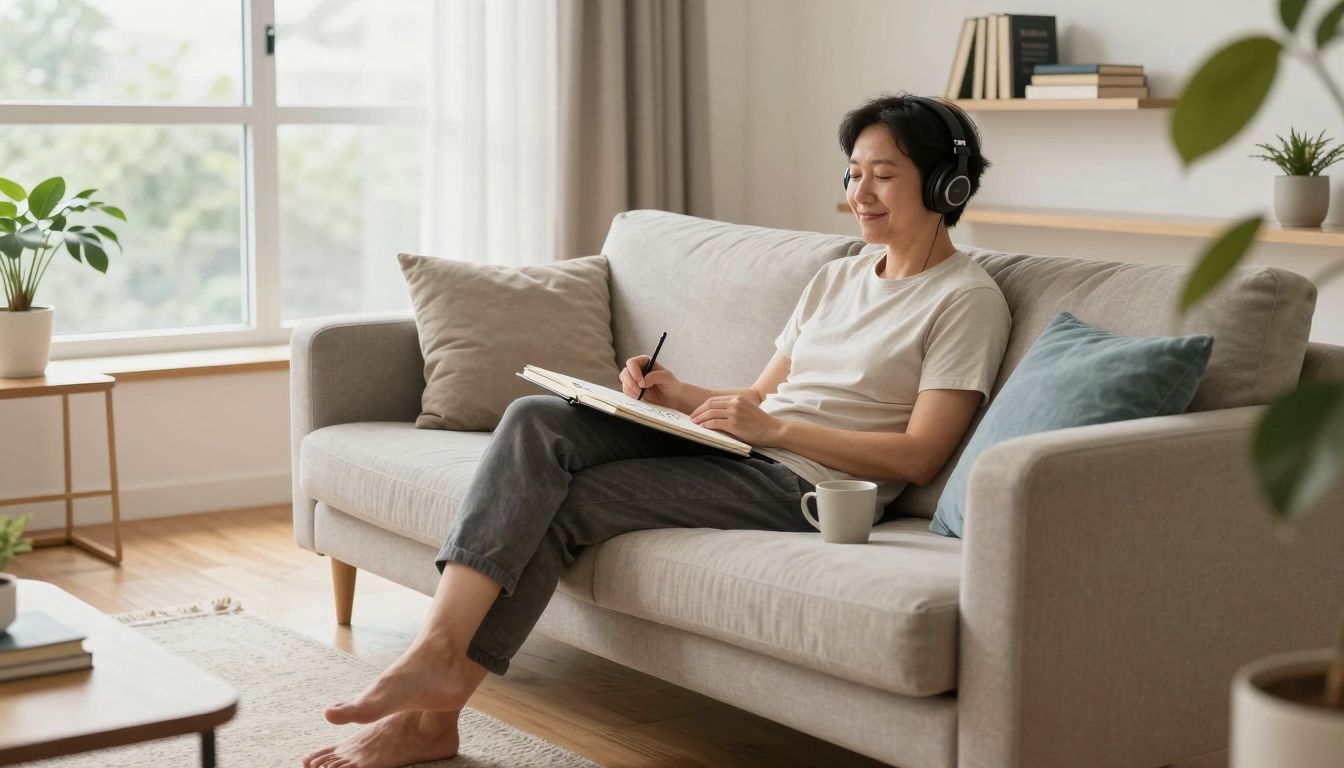
Journaling prompts (no fluff). Forget “dear diary” entries. Answer one of these in bullet points:
- What’s one thing I can control today?
- What’s draining my energy that I can say no to?
- What’s one small win from this week?
You’re not writing an essay. You’re just getting the noise out of your head and onto paper.
The sensory grounding game. Name five things you can see, four you can touch, three you can hear, two you can smell, one you can taste. It’s a classic grounding technique, and it works because it pulls you out of your racing thoughts and back into the present moment.
High-energy options (when you can actually move)
Some days, you have energy to burn—or you’re so wound up that sitting still feels impossible. Use that.
Dance it out. Close the door. Put on a song with a heavy beat or a nostalgic Bollywood track that makes you want to move. Dance badly. Jump. Shake your arms. Let yourself look ridiculous. Physical release is one of the fastest ways to metabolize stress hormones.
Interval walk. Go outside (or onto your terrace, or up and down your building’s stairs). Walk at a normal pace for two minutes, then speed up for one minute—fast enough that you’re slightly breathless. Repeat three to five times. The rhythm and the fresh air do more for your nervous system than a treadmill ever will.
The “rage clean.” Sometimes stress needs an outlet, and scrubbing the bathroom or sweeping the floor with intensity can be oddly satisfying. You’re moving, you’re accomplishing something tangible, and you’re channeling frustration into something productive.

The 2-minute rule to actually start
The biggest barrier to stress relief isn’t lack of options—it’s the gap between knowing what helps and actually doing it. Enter the 2-minute rule: commit to doing any activity for just two minutes.
Two minutes of stretching. Two minutes of cold water. Two minutes of walking. That’s it.
Nine times out of ten, once you start, you’ll keep going. But even if you don’t, two minutes still counts. It’s better than scrolling for twenty minutes and feeling worse.
Build your personal anti-stress playlist
Here’s the game-changer: don’t wait until you’re melting down to figure out what helps. Right now, while you’re calm enough to think clearly, make a list.
Divide it into three columns: low energy, medium energy, high energy. Under each, write 3–5 activities that have worked for you in the past (or that sound doable based on what you just read).
Keep it somewhere visible—your phone’s notes app, a sticky note on your desk, a page in your planner. When stress hits, you won’t have to think. You’ll just look at the list and pick one.
Here’s a sample to get you started:
Low: Cold water hands, one song walk, 60-second stretch
Medium: 10-minute declutter, journaling prompt, sensory grounding
High: Dance break, interval walk, rage clean
Your list will look different, and that’s the point. This is about what works for you, not what works for the wellness influencer on Instagram.

The takeaway
Stress relief doesn’t have to be elaborate, time-consuming, or Instagram-worthy. It just has to interrupt the spiral and give you a moment to breathe.
Some days that’s cold water on your wrists. Other days it’s a ten-minute dance party in your living room. Both count. Both matter.
The goal isn’t to eliminate stress—that’s not realistic for any adult navigating life in 2025. The goal is to have a toolkit that’s actually usable, so you’re not white-knuckling your way through every hard day.
Pick one thing from this article. Try it today. Then add it to your list.
You don’t need a perfect routine. You just need one thing that works right now.